
HYBRID ACOR–PSO APPROACH FOR THE IDENTIFICATION OF PHOTOVOLTAIC PANEL PARAMETERS
DOI:
https://doi.org/10.51646/jsesd.v14i2.531Keywords:
Ant colony, swarm optimization, photovoltaic, optimization, identificationAbstract
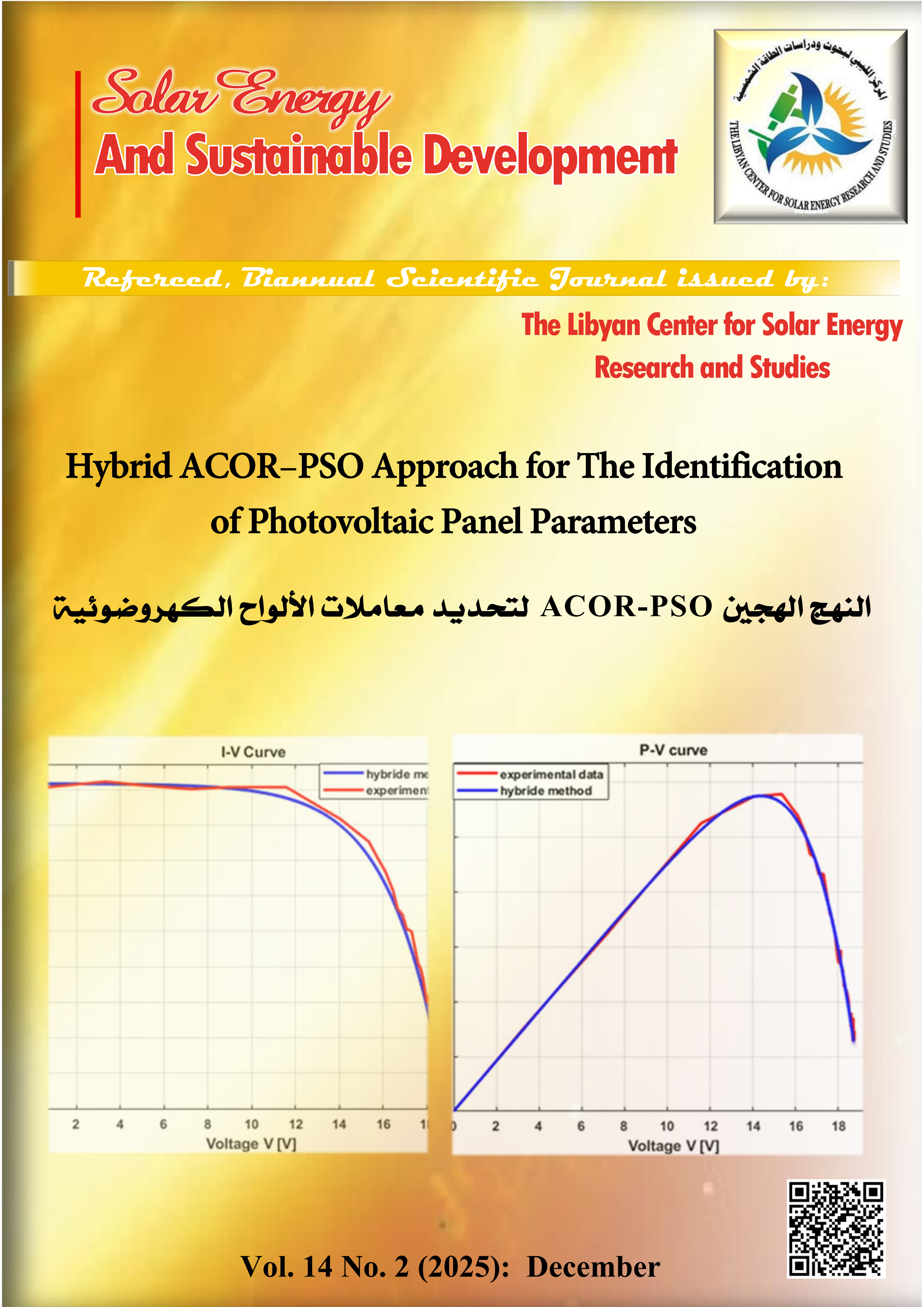
Faced with technological advances and increasing global energy demand, solar energy is positioning itself as a sustainable, clean, and secure solution, occupying a key role in contemporary energy systems. This article proposes a mixed approach to determine the parameters of a SY-M80W photovoltaic panel. The proposed technique leverages the global exploration capability of the ant colony algorithm (ACOR) in the continuous domain to generate relevant candidate solutions, while the specific swarm optimization algorithm (PSO) plays a role in the local exploitation phase to refine the search for the best solutions. This collaboration helps overcome the individual constraints of each technique, particularly deadlock or anticipated convergence. The primary goal is to optimize the accuracy, consistency, and convergence speed in estimating the five essential parameters of the diode model. Validation was performed through simulations using experimental data from tests conducted under standard environmental conditions. The results indicate that the ACOR–PSO technique provides more accurate identification, increased stability, and acceptable convergence time compared to conventional methods or a single algorithm. This approach is therefore encouraging for modeling, simulation, control, and energy optimization applications in the photovoltaic sector.
Downloads
Metrics
References
Hannouch, A., Faraj, J., Taher, R., Mortazavi, M., & Khaled, M. (2024). A simplified approach to modeling temperature dynamics in photovoltaic systems–Validation, case studies, and parametric analysis. International Journal of Thermofluids, 23, 100767.
Zhang, Y., Liu, C., Lu, H., Zhou, H., Wu, J., & Yang, M. (2024). A novel method for reference parameters identification and electrical property estimation of PV modules under varying operating conditions. Energy Conversion and Management: X, 22, 100569.
Saxena, A., Kumar, R., Amir, M., & Muyeen, S. M. (2024). Maximum power extraction from solar PV systems using intelligent based soft computing strategies: A critical review and comprehensive performance analysis. Heliyon, 10(2).
SERAPHINE, O. N. (2025). Optimisation des performances des systèmes solaires: Innovations technologiques et défis d’intégration. Journal of Business and Technologies, 1(5).
Mlazi, N. J., Mayengo, M., Lyakurwa, G., & Kichonge, B. (2024). Mathematical modeling and extraction of parameters of solar photovoltaic module based on modified Newton–Raphson method. Results in Physics, 57, 107364.
Yang, B., Wang, J., Zhang, X., Yu, T., Yao, W., Shu, H., ... & Sun, L. (2020). Comprehensive overview of meta-heuristic algorithm applications on PV cell parameter identification. Energy Conversion and Management, 208, 112595.
Hachana, O., Hemsas, K. E., Tina, G. M., & Ventura, C. (2013). Comparison of different metaheuristic algorithms for parameter identification of photovoltaic cell/module. Journal of renewable and sustainable energy, 5(5).
Zhang, Y. J., Wang, Y. F., Yan, Y. X., Zhao, J., & Gao, Z. M. (2024). Self-adaptive hybrid mutation slime mould algorithm: case studies on uav path planning, engineering problems, photovoltaic models and infinite impulse response. Alexandria Engineering Journal, 98, 364-389.
Jordehi, A. R. (2016). Parameter estimation of solar photovoltaic (PV) cells: A review. Renewable and Sustainable Energy Reviews, 61, 354–371.
Natsheh, E. M., & Albarbar, A. (2012). PV system model based on artificial neural network using Matlab/Simulink. Renewable and Sustainable Energy Reviews, 16(4), 1814–1820.
Ishaque, K., Salam, Z., & Syafaruddin, (2011). A comprehensive MATLAB Simulink PV system simulator with partial shading capability based on two-diode model. Solar Energy, 85(9), 2217–2227.
Ekinci, S., Izci, D., & Hussien, A. G. (2024). Comparative analysis of the hybrid gazelle‐Nelder–Mead algorithm for parameter extraction and optimization of solar photovoltaic systems. IET Renewable Power Generation, 18(6), 959-978.
Abdel-Basset, M., Mohamed, R., Hezam, I. M., Sallam, K. M., & Hameed, I. A. (2024). Parameters identification of photovoltaic models using Lambert W-function and Newton-Raphson method collaborated with AI-based optimization techniques: A comparative study. Expert Systems with Applications, 255, 124777.
Yang, B., Zheng, R., Qian, Y., Liang, B., & Wang, J. (2025). Efficient identification of photovoltaic cell parameters via Bayesian neural network-artificial ecosystem optimization algorithm. Global Energy Interconnection.
Shihabudheen, K. V., & Dileep, G. (2024). Adaptive particle swarm optimization based improved modeling of solar photovoltaic module for parameter determination. e-Prime-Advances in Electrical Engineering, Electronics and Energy, 8, 100621.
Hakmi, S. H., Alnami, H., Ginidi, A., Shaheen, A., & Alghamdi, T. A. (2024). A Fractional Order-Kepler Optimization Algorithm (FO-KOA) for single and double-diode parameters PV cell extraction. Heliyon, 10(16).
Yang, S., Xiong, G., Fu, X., Mirjalili, S., & Mohamed, A. W. (2024). Enhanced Whale optimization algorithms for parameter identification of solar photovoltaic cell models: a comparative study. Scientific Reports, 14(1), 16765.
Abd El-Mageed, A. A., Al-Hamadi, A., Bakheet, S., & Abd El-Rahiem, A. H. (2024). Hybrid sparrow search-exponential distribution optimization with differential evolution for parameter prediction of solar photovoltaic models. Algorithms, 17(1), 26.
Han, Y., Chen, W., Heidari, A. A., Chen, H., & Zhang, X. (2024). Balancing exploration–exploitation of multi-verse optimizer for parameter extraction on photovoltaic models. Journal of Bionic Engineering, 21(2), 1022-1054.
Elshara, R., Hançerlioğullari, A., Rahebi, J., & Lopez-Guede, J. M. (2024). PV cells and modules parameter estimation using coati optimization algorithm. Energies, 17(7), 1716.
Ashwini Kumari, P., Basha, C. H., Fathima, F., Dhanamjayulu, C., Kotb, H., & ELrashidi, A. (2024). Adaptive RAO ensembled dichotomy technique for the accurate parameters extraction of solar PV system. Scientific Reports, 14(1), 12920.
Mlazi, N. J., Mayengo, M., Lyakurwa, G., & Kichonge, B. (2024). Mathematical modeling and extraction of parameters of solar photovoltaic module based on modified Newton–Raphson method. Results in Physics, 57, 107364.
Rusirawan, D., & Farkas, I. (2014). Identification of model parameters of the photovoltaic solar cells. Energy Procedia, 57, 39-46.
Essakhi, H. (2019). modélisation et simulation d'un module photovoltaïque. LASIME, ESTA Université Ibn Zohr, BP, 33.
Rustemli, S., & Dincer, F. (2011). Modeling of photovoltaic panel and examining effects of temperature in Matlab/Simulink. Elektronika ir Elektrotechnika, 109(3), 35-40.
Miller, S. J. (2006). The method of least squares. Mathematics Department Brown University, 8(1), 5-11.
Dorigo, M., & Stutzle, T. (2004). Ant Colony Optimization. MIT Press, Cambridge, MA.
Socha, K., & Dorigo, M. (2008). Ant colony optimization for continuous domains. European journal of operational research, 185 (3), 1155–1173.
Nwohu, M., & Paul, O. O. (2017). Evaluation of economic load dispatch problem in power generating stations by the use of ant colony search algorithms. International Journal of Research Studies in Electrical and Electronics Engineering (IJRSEEE), 3 (1), 20–29.
Alaya, I., Solnon, C., & Ghédira, K. (2007). Optimisation par colonies de fourmis pour le problème du sac-`a-dos multi-dimensionnel. Revue des Sciences et Technologies de l’Information-Série TSI: Technique et Science Informatiques, 26, 371–390.
Benyamina, A. (2013). Application des algorithmes de colonies de fourmis pour l’optimisation et la classification des images. Ph.D. thesis, USTO (MB).
Socha, K. (2009). Ant colony optimisation for continuous and mixed-variable domains. Citeseer.
Dréo, J., & Siarry, P. (2006). An ant colony algorithm aimed at dynamic continuous opti- mization. Applied Mathematics and Computation, 181 (1), 457–467.
Khezzane, K., & Khoucha, F. (2014). Application de la Technique PSO pour la Poursuite du PPM d'un Système Photovoltaïque. In 3nd Int. Semin. New Renew. Energies (pp. 1-6).
Ishaque, K., Salam, Z., Amjad, M., & Mekhilef, S. (2012). An improved particle swarm optimization (PSO)–based MPPT for PV with reduced steady-state oscillation. IEEE transactions on Power Electronics, 27(8), 3627-3638.
F. Hamidia, A. Abbadi, Improved hybrid pumping system with storage battery based on particle swarm algorithm, Rev. Roum. Sci. Techn.– Électrotechn. et Énerg., 66, 4, pp. 243–248 (2021).
Yousri, D., Thanikanti, S. B., Allam, D., Ramachandaramurthy, V. K., & Eteiba, M. B. (2020). Fractional chaotic ensemble particle swarm optimizer for identifying the single, double, and three diode photovoltaic models’ parameters. Energy, 195, 116979.
Obukhov, S., Ibrahim, A., Diab, A. A. Z., Al-Sumaiti, A. S., & Aboelsaud, R. (2020). Optimal performance of dynamic particle swarm optimization-based maximum power trackers for stand-alone PV system under partial shading conditions. IEEE Access, 8, 20770–20785.
Downloads
Published
How to Cite
Issue
Section
License
Copyright (c) 2026 Hizia Abed, Sihem Bouri

This work is licensed under a Creative Commons Attribution-NonCommercial 4.0 International License.