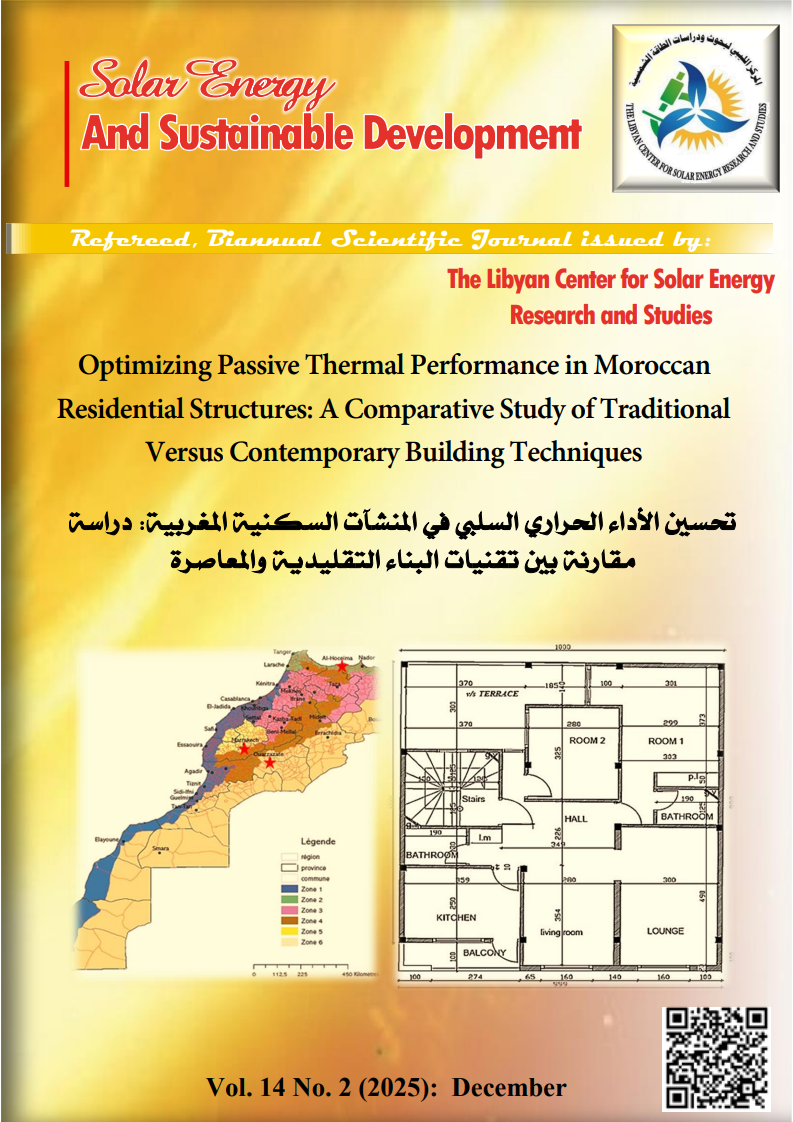
تحليل الأداء الحراري لمبنى سكني بالنسبة لثلاث سيناريوهات بناء مختلفة في المغرب
A Comparative Study of Traditional Versus Contemporary Building Techniques
DOI:
https://doi.org/10.51646/jsesd.v14i2.482الكلمات المفتاحية:
Hempcrete، Energy consumption، Thermal comfort، dynamic simulations، Climatic zones.الملخص
يعد قطاع البناء في المغرب من أكبر مستهلكي الطاقة، حيث يمثل حوالي 33٪ من إجمالي استهلاك الطاقة في البلاد. ويعزى هذا الطلب المرتفع أساسًا إلى أنظمة التدفئة والتهوية وتكييف الهواء، خاصة في المناطق التي تتميز بدرجات حرارة شديدة. لمعالجة هذا التحدي، تهدف الاستراتيجية الوطنية لكفاءة الطاقة في المغرب إلى تقليص استهلاك الطاقة بنسبة 15٪ بحلول عام 2030 من خلال خطط عمل تستهدف عدة قطاعات رئيسية، بما في ذلك المباني. تعد هذه المقاربة جزءًا من رؤية أوسع لتعزيز كفاءة الطاقة وتشجيع استخدام مواد البناء المستدامة.
في هذا السياق، يقيم هذا المقال الأداء الحراري والطاقي لمبنى سكني من خلال دمج مواد صديقة للبيئة تعتمد على القنب. يتم التحقيق في الخرسانة المصنوعة من القنب، المعروفة بخصائصها في العزل الحراري، كبديل مستدام لتحسين كفاءة الطاقة في المباني. تم إجراء محاكاة عددية باستخدام برنامج Trnsys في أربع مدن مغربية ذات ظروف مناخية متنوعة: الحسيمة (مناخ متوسطي)، وجدة (مناخ قاري)، مراكش (مناخ شبه جاف)، و ورزازات (مناخ صحراوي). تظهر النتائج أن دمج الخرسانة المصنوعة من القنب يمكن أن يقلل من احتياجات التدفئة بنسبة تصل إلى 39٪ واحتياجات التبريد بنسبة 15٪. علاوة على ذلك، تعزز هذا المادة الراحة الحرارية الداخلية، مع زيادة في درجة الحرارة بمتوسط 0.77 درجة مئوية في الشتاء وانخفاض قدره 0.62 درجة مئوية في الصيف، مما يساهم في تعزيز كفاءة الطاقة وتقليل بصمة الكربون في المباني.
التنزيلات
المقاييس
المراجع
Agence Marocaine de l'Efficacité Énergétique (AMEE). (2024). Energy efficiency in buildings. (accessed March 2, 2025), from https://www.amee.ma/en/node/118.
Bennouna, A., & El Hebil, C. (2016). Energy needs for Morocco 2030, as obtained from GDP-energy and GDP-energy intensity correlations. Energy Policy, 88, 45-55. doi : https://doi.org/10.1016/j.enpol.2015.10.003. DOI: https://doi.org/10.1016/j.enpol.2015.10.003
Allouhi, A., El Fouih, Y., Kousksou, T., Jamil, A., Zeraouli, Y., & Mourad, Y. (2015). Energy consumption and efficiency in buildings: current status and future trends. Journal of Cleaner production, 109, 118-130. doi : https://doi.org/10.1016/j.jclepro.2015.05.139. DOI: https://doi.org/10.1016/j.jclepro.2015.05.139
Ministère de l'Énergie, des Mines et de l'Environnement. (2024). National energy efficiency strategy. (accessed March 2, 2025).
Charai, M., Sghiouri, H., Mezrhab, A., & Karkri, M. (2021). Thermal insulation potential of non-industrial hemp (Moroccan cannabis sativa L.) fibers for green plaster-based building materials. Journal of Cleaner Production, 292, 126064. doi : https://doi.org/10.1016/j.jclepro.2021.126064. DOI: https://doi.org/10.1016/j.jclepro.2021.126064
Benfars, M., Alioui, A., Azalam, Y., Kaddiri, M., & Mabrouki, M. (2024). Impact of Ecological Thermal Roof Insulation on the Energy Efficiency of Conventional Buildings in a Semi-Arid Climate. Solar Energy and Sustainable Development Journal, 78-88. doi : DOI: https://doi.org/10.51646/jsesd.v14iSI_MSMS2E.401
https://doi.org/10.51646/jsesd.v14iSI_MSMS2E.401.
Dlimi, M., Agounoun, R., Kadiri, I., Saadani, R., & Rahmoune, M. (2023). Thermal performance assessment of double hollow brick walls filled with hemp concrete insulation material through computational fluid dynamics analysis and dynamic thermal simulations. DOI: https://doi.org/10.1016/j.prime.2023.100124
e-Prime-Advances in Electrical Engineering, Electronics and Energy, 3, 100124. doi : https://doi.org/10.1016/j.prime.2023.100124.
Essaghouri, L., Mao, R., & Li, X. (2023). Environmental benefits of using hempcrete walls in residential construction: An LCA-based comparative case study in Morocco. Environmental Impact Assessment Review, 100, 107085. doi : https://doi.org/10.1016/j.eiar.2023.107085. DOI: https://doi.org/10.1016/j.eiar.2023.107085
Kaddouri, H., Abidouche, A., Alaoui, M. S. H., Driouch, I., & Hamdaoui, S. (2024). Impact of Insulation using Bio-sourced Materials on the Thermal and Energy Performance of a Typical Residential Building in Morocco. Journal of Advanced Research in Fluid
Mechanics and Thermal Sciences, 117(1), 43-59. doi: https://doi.org/10.37934/arfmts.117.1.4359.
Kaddouri, H., Abidouche, A., Alaoui, M. S. H., Driouch, I., Msaad, A. A., & Hamdaoui, S. (2024). Numerical simulation study of the effect of integrating hemp concrete and passive strategies on the energy consumption of a residential building in Al-Hoceima. Statistics, Optimization & Information Computing, 12(3), 727-736. doi: https://doi.org/10.19139/soic2310-5070-1933. DOI: https://doi.org/10.19139/soic-2310-5070-1933
Abidouche, A., Kaddouri, H., Hamdaoui, S., Msaad, A. A., Driouch, I., & Hassani, A. M.S. (2024). The analysis of occupants’ thermal comfort in a residential building in Tangier, Morocco. Mathematical Modeling and Computing, 752. doi: https://doi.org/10.23939/mmc2024.03.752. DOI: https://doi.org/10.23939/mmc2024.03.752
Greencore Construction. (2022). Post-occupancy evaluation of The Triangle low-carbon housing development [Technical report]. https://www.greencoreconstruction.co.uk/reports.
IRESEN. (2023). Bioclimatic villa prototype report. Institute for Solar Energy and New Energies.
Ministère de la Transition écologique. (2021). Plan de relance bâtiment durable: Objectifs et stratégies pour l’intégration des matériaux biosourcés (pp. 42–45). https://www.ecologie.gouv.fr.
Canadian Standards Association. (2024). National Building Code of Canada 2025: Proposed amendments (Report No. NBC 2025-PC-01.3.2). CSA Group.
RTCM. Moroccan thermal construction regulations. Agence Marocaine de l'Efficacité Énergétique. (accessed March 2, 2025). https://www.amee.ma/sites/default/files/inlinefiles/Reglement%20thermique%20de%20construction%20au%20Maroc.pdf.
Meteonorm Global Meteorological Database Version 8.0.2 (2020), www.meteonorm.com. (accessed March 2, 2025).
Binayate Perspective, National Agency for Energy Efficiency, Morocco (2014).
Samri, D. Physical analysis and hygrothermal characterisation of building materials: experimental approach and numerical modelling. PhD. Ecole Nationale des Travaux Publics de l'Etat, Vaulx-en-Velin, 2008.
Collet, F. Hydric and Thermal Characterization of Engineering Materials. PhD diss., National Institute of Applied Sciences, Rennes, 2018.
Trnsys 18 manual (2018), https://www.trnsys.com. (accessed March 2, 2025)
Kusuda, T., & Achenbach, P. R. (2006). Earth temperature and thermal diffusivity at selected stations in the United States. doi : https://doi.org/10.21236/AD0472916.
ISO. (2010). ISO 7730 : Ergonomie des ambiances thermiques – Détermination analytique et interprétation du confort thermique par le calcul des indices PMV et PPD et par des critères de confort thermique local. Institut Marocain de Normalisation.
Eddib, F., & Lamrani, M. A. (2019). Effect of the thermal insulators on the thermal and energetic performance of the envelope of a house located in Marrakesh. Alexandria Engineering Journal, 58(3), 937-944. doi : https://doi.org/10.1016/j.aej.2019.08.008. DOI: https://doi.org/10.1016/j.aej.2019.08.008
التنزيلات
منشور
كيفية الاقتباس
إصدار
القسم
الرخصة
الحقوق الفكرية (c) 2026 Hicham Kaddouri, Abderrahim Abidouche, Mohamed Saidi Hassani Alaoui, Ismael Driouch, Firyal Latrache, Abderrahim Ed-Daoui

هذا العمل مرخص بموجب Creative Commons Attribution-NonCommercial 4.0 International License.