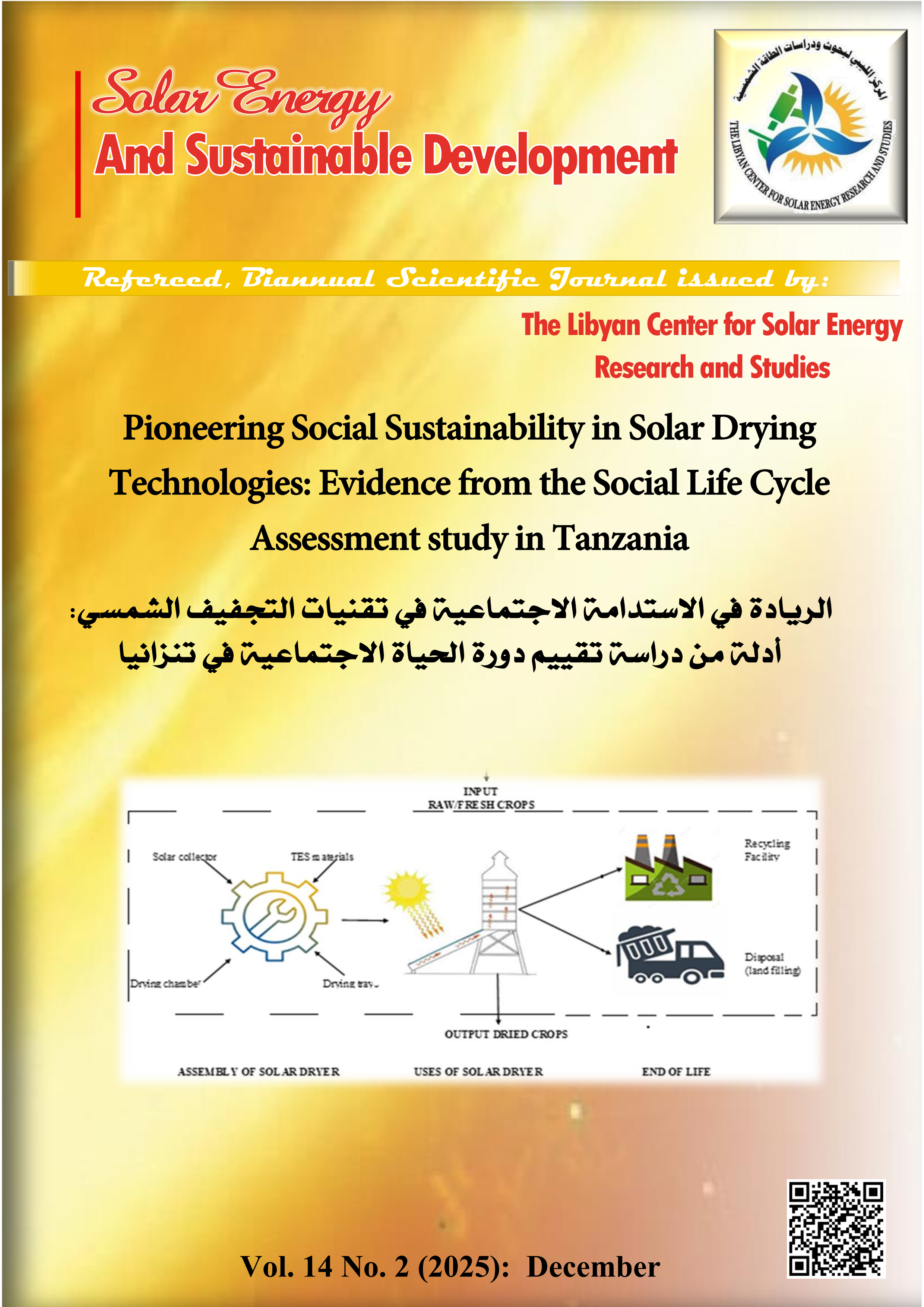
Pioneering Social Sustainability in Solar Drying Technologies: Evidence from the SLCA study in Tanzania
DOI:
https://doi.org/10.51646/jsesd.v14i2.653الكلمات المفتاحية:
Socila Life Cycle Assessment (SLCA), Solar Drying Technologies (SDTs), Post Harvest Loss (PHL), Indicators, Social Sustainabilityالملخص
Solar drying technologies (SDTs) are increasingly used to reduce post-harvest losses and extend the shelf life of agricultural produce. However, despite their benefits, studies have noted potential socio-economic and environmental impacts on humans and ecosystems. This study applied the Social Life Cycle Assessment (SLCA) framework to evaluate the social impacts of SDTs in Morogoro and Arusha regions, Tanzania. Using a participatory approach, focus group discussions with stakeholders identified 16 core social issues expanded into 56 SLCA sub-indicators. A structured questionnaire was administered to 244 respondents, including farmers and entrepreneurs. Results show SDTs contribute significantly to food security, reduced post-harvest losses, and improved market access. However, concerns include poor end-of-life management of SDT components, weak policy and legal frameworks, unequal working conditions, and limited social protection. Regionally, Morogoro outperformed Arusha across most indicators, with Arusha requiring targeted interventions. This is the first comprehensive SLCA study on SDTs in Africa, introducing two new indicators “improved food quality” and “food security” into SLCA methodology. The study enhances traditional life cycle assessments by focusing on social sustainability, providing critical insights for policymakers and planners seeking to promote sustainable agricultural technologies.
Keywords:
التنزيلات
المقاييس
التنزيلات
منشور
كيفية الاقتباس
إصدار
القسم
الرخصة
الحقوق الفكرية (c) 2026 Ashiraf Abeid, Felichesmi Lyakurwa, Eliza Mkuna

هذا العمل مرخص بموجب Creative Commons Attribution-NonCommercial 4.0 International License.