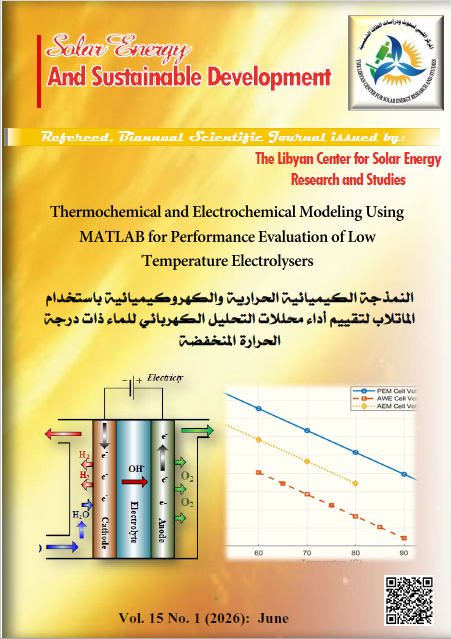
Thermochemical and Electrochemical Modeling Using MATLAB for Performance Evaluation of Low Temperature Electrolysers
DOI:
https://doi.org/10.51646/jsesd.v15i1.863الكلمات المفتاحية:
Water electrolysis, low operating temperature, hydrogen production, Electrochemical, temperatureالملخص
الملخص: تقدم هذه الدراسة نموذج ا حاسوبي ا قائ ما على برنامج MATLAB لتحليل الديناميكا الحرارية والكيمياء الكهربائية لمحللات الماء منخفضة الحرارة بنوعيها: غشاء التبادل البروتوني (PEM) ومحللات الماء القلوية (AWE). يتنبأ النموذج بدقة بالحدود الديناميكية الحرارية ومؤشرات الأداء الرئيسية، بما في ذلك جهد الخلية العكوس ومعدل إنتاج الهيدروجين، كدالة لدرجة حرارة التشغيل. تُظهر النتائج باستمرار أن زيادة درجة الحرارة تقلل من جهد الخلية العكوس وتغير طاقة غيبس الحرة ΔG) (، مما يقلل بدوره من الطاقة الكهربائية المطلوبة لتحليل الماء مع زيادة معدلات إنتاج الهيدروجين في آن واحد. على الرغم من أن درجات الحرارة المرتفعة تؤدي إلى زيادة الطلب على الطاقة الحرارية، إلا أن محلل PEM يُظهر عمو ما كفاءة طاقة أعلى، خاصة عند كثافات التيار المرتفعة، مقارنة بمحلل AWE. يقدم هذا البحث رؤى قيمة لتحسين ظروف التشغيل لتعزيز كفاءة وقدرات إنتاج الهيدروجين لمحللات الماء منخفضة الحرارة، مما يساهم في تقدم تكنولوجيا توليد الهيدروجين المستدام
التنزيلات
المقاييس
المراجع
W. Li, H. Tian, L. Ma, Y. Wang, X. Liu, and X. Gao, “Low-temperature water electrolysis: fundamentals, progress, and new strategies,” Mater. Adv., vol. 3, no. 14, pp. 5598–5644, 2022, doi: 10.1039/d2ma00185c.
M. E. Şahin, “An Overview of Different Water Electrolyser Types for Hydrogen Production,” Energies (Basel)., vol. 17, no. 19, p. 4944, Oct. 2024, doi: 10.3390/en17194944.
A. Franco and C. Giovannini, “Recent and Future Advances in Water Electrolysis for Green Hydrogen Generation: Critical Analysis and Perspectives,” Sustainability (Switzerland), vol. 15, no. 24, 2023, doi: 10.3390/su152416917.
A. Pozio, F. Bozza, G. Nigliaccio, M. Platter, and G. Monteleone, “Development perspectives on low-temperature electrolysis,” Energia, ambiente e innovazione, vol. 1, pp. 66–71, 2021, doi: 10.12910/EAI2021-014.
K. W. Harrison, Remick R., G. D. Martin, and A. Hoskin, “Hydrogen Production: Fundamentals and Case Study Summaries,” Hydrogen and fuel cells, no. January, pp. 207–226, 2010.
A. Chandrasekar and B. Westlake, “MODELING THE FLEXIBLE OPERATION OF ELECTROLYSERS FOR HYDROGEN PRODUCTION IN A LOW-CARBON ENERGY SYSTEM Important Considerations,” no. August, pp. 0–9, 2022, [Online]. Available: https://us-regen-docs.epri.com.
L. Jin, R. N. Nakashima, G. Comodi, and H. L. Frandsen, “Alkaline electrolysis for green hydrogen production: techno-economic analysis of temperature influence and control,” 36th International Conference on Efficiency, Cost, Optimization, Simulation and Environmental Impact of Energy Systems, ECOS 2023, pp. 908–919, 2023, doi: 10.52202/069564-0082.
C. Laghlimi, A. Moutcine, Y. Ziat, A. Koufi, S. Bouyassan, and H. Belkhanchi, “Hydrogen: chronology and electrochemical production Charaf,” Solar Energy and Sustainable Development, vol. 0, no. The 2024 1st International Conference on Materials Sciences and Mechatronics for Sustainable Energy and the Environment, pp. 22–37, 2024, doi: https://doi.org/10.51646/10.51646/jsesd.v14iSI_MSMS2E.405.
A. Bouzaid, Y. Ziat, H. Belkhanchi, and H. Fatihi, “Boosting the photocatalytic hydrogen production via the S/Zr co-doping in a CaTiO3 perovskite: first-principles study of the optoelectronic, thermodynamic, and photocatalytic,” European Physical Journal B, vol. 98, no. 7, 2025, doi: 10.1140/epjb/s10051-025-01004-2.
A. Bouzaid, Y. Ziat, and H. Belkhanchi, “Prediction the effect of (S, Se, Te) doped MgTiO3 on optoelectronic, catalytic, and pH conduct as promised candidate photovoltaic device: Ab initio framework,” Int. J. Hydrogen Energy, vol. 100, pp. 20–32, Jan. 2025, doi: 10.1016/j.ijhydene.2024.12.284.
and A. E. Rakesh Krishnamoorthy lyer, Jarod C. Kelly, “Electrolysers for Hydrogen Production: Solid Oxide, Alkaline, and Proton Exchange Membrane,” 2022.
M. El-Shafie, “Hydrogen production by water electrolysis technologies: A review,” Results in Engineering, vol. 20, Dec. 2023, doi: 10.1016/j.rineng.2023.101426.
F. Gambou, D. Guilbert, M. Zasadzinski, and H. Rafaralahy, “A Comprehensive Survey of Alkaline Electrolyser Modeling: Electrical Domain and Specific Electrolyte Conductivity,” Energies (Basel)., vol. 15, no. 9, p. 3452, May 2022, doi: 10.3390/en15093452.
M. Nasser, T. F. Megahed, S. Ookawara, and H. Hassan, “A review of water electrolysis–based systems for hydrogen production using hybrid/solar/wind energy systems,” Environmental Science and Pollution Research, vol. 29, no. 58, pp. 86994–87018, Dec. 2022, doi: 10.1007/s11356-022-23323-y.
N. Gallandat, K. Romanowicz, and A. Züttel, “An Analytical Model for the Electrolyser Performance Derived from Materials Parameters,” Journal of Power and Energy Engineering, vol. 05, no. 10, pp. 34–49, 2017, doi: 10.4236/jpee.2017.510003.
M. Pfennig, B. Schiffer, and T. Clees, “Thermodynamical and electrochemical model of a PEM Electrolyser plant in the megawatt range with a literature analysis of the fitting parameters,” Int. J. Hydrogen Energy, Feb. 2024, doi: 10.1016/j.ijhydene.2024.04.335.
H. W. J. Sol A Lee, Jaehyun Kim, Ki Chang Kwon, Sun Hwa Park, “Anion exchange membrane water electrolysis for sustainable large‐scale hydrogen production,” Carbon Neutralization -WILEY, vol. 1, no. 1, pp. 26–48, 2022, doi: 10.1002/cnl2.9.
A. Hasan, V. Prasad, S. Afghan, F. Khalid, M. Hanafi, and B. Azami, “International Journal of Hydrogen Energy Mathematical modelling of a photoelectrochemical anion exchange membrane electrolyser for sustainable hydrogen production,” Int. J. Hydrogen Energy, vol. 140, no. November 2024, pp. 1233–1240, 2025, doi: 10.1016/j.ijhydene.2024.11.415.
Z. Fang et al., “Review Stability challenges of anion-exchange membrane water Electrolysers from components to integration level,” Chem Catalysis, vol. 4, no. 10, p. 101145, 2024, doi: 10.1016/j.checat.2024.101145.
A. L. Dicks and D. A. J. Rand, Fuel cell systems explained, 3rd ed. John Wiley & Sons, 2018. doi: 10.1002/9781118706992.
C. Borgnakke and R. E. Sonntag, Fundamentals of thermodynamics. John Wiley & Sons, 2020.
N. Srivastava, “Modeling of solid oxide fuel cell/gas turbine hybrid systems,” 2006.
T. M. Koehler, D. B. Jarrell, and L. J. Bond, “High Temperture Ceramic Fuel Cell Measurement and Diagnostics for Application to Solid Oxide Fuel Cell Systems,” Office of Scientific and Technical Information ({OSTI}), 2001. doi: 10.2172/965697.
K. Annamalai, I. K. Puri, and M. A. Jog, Advanced Thermodynamics Engineering. 2011. doi: 10.1201/9781439805718.
W. Winkler, Thermodynamics. Elsevier, 2016. doi: 10.1016/B978-0-12-410453-2.00003-8.
M. K. ÇENGEL, YUNUS A, MICHAEL A. BOLES, THERMODYNAMICS: AN ENGINEERING APPROACH, NINTH EDITION. 2016.
C. BORGNAKKE and R. E. SONNTAG, FUNDAMENTALS OF THERMODYNAMICS, 7th ed. 2009.
NETL, “Seventh Edition Fuel Cell Handbook,” Pittsburgh, PA, and Morgantown, WV, 2004. doi: 10.2172/834188.
I. H. Tawil, F. M. Bsebsu, and H. Abdulkader, “Thermodynamic Study of Operation Properties Effect on Polymer Electrolyte Membrane Fuel Cells (PEM),” Solar Energy and Sustainable Development journal, vol. 7, no. 1, Feb. 2021, doi: 10.51646/jsesd.v7i1.67.
T.-I. Tsai, “Carbon Formation in Solid Oxide Fuel Cells During Internal Reforming and Anode Off-Gas Recirculation,” The University of Birmingham.
K. M. J. Andersson, “Solid Oxide Fuel Cell Modeling at the Cell Scale,” Lund University. doi: 10.13140/RG.2.2.12858.59846.
S. R. Pakalapati and I. Celik, “A new reduced order model for solid oxide fuel cells,” West Virginia University Libraries, 2006. doi: 10.33915/etd.3458.
S. Yosaf, H. Gnaifaid, and A. Mizda, “Thermoeconomic Assessments of Green Hydrogen Production Via PV&PEM Electrolyser:,” Solar Energy and Sustainable Development Journal, vol. 13, no. 1, pp. 57–70, Mar. 2024, doi: 10.51646/jsesd.v13i1.172.
H. Ahmed and A. Musa, “Performance Investigation of Direct oupling Advanced Alkaline Electrolysis and PEMFC System,” Solar Energy and Sustainable Development journal, vol. 9, no. 2, 2021, doi: 10.51646/jsesd.v9i2.7.
J. Wang, J. Wen, J. Wang, B. Yang, and L. Jiang, “Water Electrolyser operation scheduling for green hydrogen production: A review,” Renewable and Sustainable Energy Reviews, vol. 203, 2024, doi: 10.1016/j.rser.2024.114779.
M. PINO KIRSCH, Nilsson, “Electrolyser Performance and Degradation under Various Load Shapes,” KTM, 2024.
M. Carmo, D. L. Fritz, J. Mergel, and D. Stolten, “A comprehensive review on PEM water electrolysis,” Int. J. Hydrogen Energy, vol. 38, no. 12, pp. 4901–4934, 2013, doi: 10.1016/j.ijhydene.2013.01.151.
H. A. Khater, A. A. Abdelraouf, and M. H. Beshr, “Optimum Alkaline Electrolyser-Proton Exchange Membrane Fuel Cell Coupling in a Residential Solar Stand-Alone Power System,” ISRN Renewable Energy, vol. 2011, pp. 1–13, 2011, doi: 10.5402/2011/953434.
Á. Hernández-Gómez, V. Ramirez, D. Guilbert, and C. Consumption´angel Hernández-Gómez, “Investigation of PEM Electrolyser modeling: Electrical domain, efficiency, and specific energy consumption Investigation of PEM Electrolyser model-ing: Electrical domain, efficiency, and specific energy consumption Investigation of PEM Electrolyser modeli,” Int. J. Hydrogen Energy, 2020, doi: 10.1016/j.ijhydene.2020.03.195ï.
F. Calise, F. L. Cappiello, L. Cimmino, M. D. D’accadia, and M. Vicidomini, “Dynamic simulation and thermoeconomic analysis of a hybrid renewable system based on PV and fuel cell coupled with hydrogen storage,” Energies (Basel)., vol. 14, no. 22, 2021, doi: 10.3390/en14227657.
H. F. Araújo, J. A. Gómez, and D. M. F. Santos, “Proton-Exchange Membrane Electrolysis for Green Hydrogen Production: Fundamentals, Cost Breakdown, and Strategies to Minimize Platinum-Group Metal Content in Hydrogen Evolution Reaction Electrocatalysts,” Catalysts, vol. 14, no. 12, 2024, doi: 10.3390/catal14120845.
H. L. Lord, W. Zhan, and J. Pawliszyn, “Fundamentals and Applications of Needle Trap Devices,” in Comprehensive Sampling and Sample Preparation, Elsevier, 2012, pp. 677–697. doi: 10.1016/B978-0-12-381373-2.00056-9.
H. Sayed-Ahmed, I. Toldy, and A. Santasalo-Aarnio, “Dynamic operation of proton exchange membrane Electrolysers—Critical review,” Renewable and Sustainable Energy Reviews, vol. 189, no. PA, p. 113883, 2024, doi: 10.1016/j.rser.2023.113883.
Á. Hernández-Gómez, V. Ramirez, and D. Guilbert, “Investigation of PEM Electrolyser modeling: Electrical domain, efficiency, and specific energy consumption,” Int. J. Hydrogen Energy, vol. 45, no. 29, pp. 14625–14639, 2020, doi: 10.1016/j.ijhydene.2020.03.195.
M. Khaleel et al., “Towards Hydrogen Sector Investments for Achieving Sustainable Electricity Generation,” Solar Energy and Sustainable Development, vol. 13, no. 1, pp. 71–96, 2024, doi: 10.51646/jsesd.v13i1.173.
K. W. Harrison, Remick R., G. D. Martin, and A. Hoskin, “Hydrogen Production: Fundamentals and Case Study Summaries,” Hydrogen and fuel cells, no. January, pp. 207–226, 2010.
M. M. Rashid, M. K. Al Mesfer, H. Naseem, and M. Danish, “Hydrogen Production by Water Electrolysis: A Review of Alkaline Water Electrolysis, PEM Water Electrolysis and High Temperature Water Electrolysis,” Int. J. Eng. Adv. Technol., vol. 8958, no. 3, pp. 2249–8958, 2015.
التنزيلات
منشور
كيفية الاقتباس
إصدار
القسم
الرخصة
الحقوق الفكرية (c) 2026 ibrahim tawil, Zahra Gebre, Salem Khamkhem, Abdulnasir Amir

هذا العمل مرخص بموجب Creative Commons Attribution-NonCommercial 4.0 International License.